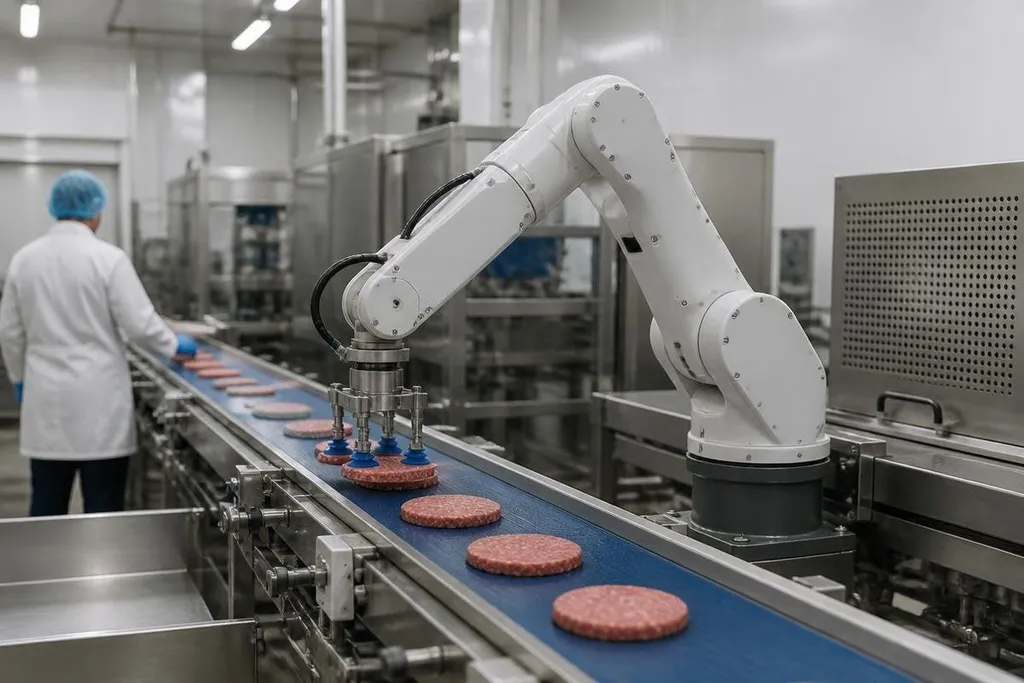
A robot moving food can affect safety at every handoff, from raw ingredients entering a line to sealed products leaving it. The useful question for a plant manager is where automation can reduce contact, catch faults, and create records without hiding gaps in the process.
- Robotic arms can move food while limiting direct hand contact.
- Vision systems can check labels, seals, surfaces, and product position.
- Sensors help staff find temperature or process changes before release.
Where robots reduce food contact
Human contact remains one route for contamination. On a production line, a robotic arm can pick, place, sort, or pack food after staff load the line, reducing the number of times people touch exposed product.
The design matters more than the word “robot.” Food equipment needs surfaces that can be cleaned, sealed joints, and materials suited to washdown.
Gaps around a robot’s wrist or exposed cables can add cleaning work instead of removing it.
The same rule applies to grippers. Suction cups, forks, and soft fingers each leave a different cleaning task. A plant should check the gripper after a full shift, during a changeover, and after any product spill.
What cameras and sensors can check
Machine vision uses cameras and software to inspect items as they move. It can check a label position, a missing seal, a damaged package, or an object in the wrong place. The system then sends a reject signal or alerts a worker.
That check only works when the plant has set clear limits. A camera needs the right lighting, a stable view, and sample products that show real faults. Condensation, sauce on a lens, or a new package design can change the result.
Temperature sensors support another part of food safety. They can record conditions in a cooler, oven, storage area, or transport container. A sensor does not decide why a reading changed, so staff still need a response plan and a record of what they did.
That response plan also needs evidence from the production line. Food safety robotics reporting can connect a robot’s task to its cleaning records and staff actions, so you can check whether the system supports a safe process or leaves required steps to people.
Records matter as much as motion
Food plants need records that show what happened, when it happened, and who responded. The controller can log a pick, a reject, a stop, or a sensor reading. That record can help staff trace a fault to a time, line, or batch.
Data still needs a clear owner. If a vision system rejects 2% of a run, someone must check the rejected items and decide if the cause was a real food fault, a dirty lens, or a setup error. Automation can collect the event; trained staff must judge the response.
A food safety plan, such as a hazard analysis and critical control points (HACCP) plan, should define the checks before a robot is added. The plan should state what the robot checks, the limit for action, the person responsible, and the record that proves the check happened.
Where automation can fail
Robots can repeat a task, but repetition does not make a task safe. A poorly placed arm can spread material between products. A sensor can drift. A software change can alter the reject rule. Cleaning staff can also miss parts that were hidden behind a guard or tool.
I’d spend money on cleanable equipment, sensor checks, and staff training before buying a robot for a task that has no clear safety record.
The plant should test the full work area, including changeovers and cleaning. A system that works with one product may need new settings for another product, package, speed, or lighting condition.
A practical buying checklist
Use these questions before adding automation to a food line:
- Map the handoffs: list every point where people, tools, packaging, and exposed food meet.
- Check the clean-down: inspect joints, cables, grippers, guards, and hard-to-reach surfaces.
- Set the action limit: write what reading or fault stops the line and who responds.
- Test real faults: include dirty packaging, poor labels, spills, condensation, and product changes.
- Keep the record: store robot events with batch, time, line, and staff response details.
The next useful step is a small trial at one handoff with a written cleaning method and a clear reject rule. If the plant cannot explain what the robot checks and what staff do after a fault, the line needs a better safety plan before it needs more automation.